
Understanding Clark County Releases
A release is the terminal movement recorded by one custodian. It can mean return to the community on bond or recognizance, completion of a jail term, a court-ordered discharge, parole from a Nevada prison, or movement to another authority. That last category matters in Clark County. A transfer from the Clark County Detention Center to the Nevada Department of Corrections, another city jail, the U.S. Marshals Service, or immigration custody ends one jail stay without making the person free in the community.
Clark County is not served by one roster. CCDC, Las Vegas, Henderson, North Las Vegas, Mesquite, and the Boulder City contract path use different custody and court systems. Several NDOC institutions also sit inside the county. Start with the agency that had custody at the end, not merely the place of arrest. A person missing from CCDC might be released, transferred, protected from display, under 18, recorded under another spelling, or held by a city facility.
- Discharge
- The end of a correctional sentence or other custody authority.
- Time served
- Release after the required jail term or credited time has been satisfied.
- Parole
- Conditional community supervision after part of a prison sentence.
- Probation
- Court-ordered supervision that may occur instead of, or after, jail time.
Clark County Release Types
The release description determines the next useful source. Do not turn a bond entry, parole grant, or transfer into proof of physical exit. Processing, another case, a detainer, or a receiving agency can keep custody in place after an initial decision.
| Release type | Meaning | Next record |
|---|---|---|
| Bond or recognizance | The court permits community release while the case continues. | Detention movement and court docket |
| Time served or sentence satisfied | The local term has ended. | Jail release record and judgment |
| Parole | Prison custody changes to supervised community status. | NDOC release data, Parole Board action, and NPP status |
| Court-ordered release or dismissal | A judicial order ends the legal hold in that case. | Court minutes plus the physical release entry |
| Transfer | Another jail, NDOC, federal, or immigration authority takes custody. | The receiving agency's locator or records office |
A court order explains legal authority, while a detention movement records what happened at the door. Both can be needed. An order may precede physical release, and a jail transfer can occur after a local case ends.
Clark County Release Record Fields
A narrow request is more useful than asking an agency to find “everything.” Identify the booking and name the fields required. Custodians may redact sealed, juvenile, medical, victim, security, or personal identifying material. They provide existing records, not a new legal conclusion.
| Field | What it establishes |
|---|---|
| Legal name, aliases, and permitted identifier | Connects the response to the correct person. |
| Booking or inmate number | Links events within the correct detention stay. |
| Originating case number | Connects custody with court minutes and orders. |
| Arrest and booking time | Marks the start of the recorded stay. |
| Releasing facility | Identifies which office processed the terminal movement. |
| Actual release date and time | Records when the movement was completed. |
| Disposition or destination | Distinguishes bond, time served, parole, community release, or transfer. |
| Releasing authority | Names the court or office and any maintained order number. |
| Transfer destination | Points to the next custodian when public. |
| Correction or amendment | Shows whether the original entry later changed. |
Charges and their maintained disposition, a bond transaction, a booking photograph, and property documentation may also be responsive. Access depends on the requester and the law. A photo proves booking, not guilt, release, or present custody.
Request Clark County Release Records
For a CCDC stay, begin with the LVMPD Public Records process. Clark County's general request portal expressly says it is not the custodian of police, detention, or court records. A court order should instead go to the clerk for the court that handled the case. NDOC records belong with the state corrections system.
- Identify the last facility, full name, booking number, and case number if known.
- Ask for the existing booking movement or release entry and list the exact fields needed.
- Specify a date range and whether the request includes a booking photo, release order, or later correction.
- Ask the custodian for a cost estimate before copies are made.
- Compare the response with the court docket or receiving agency when it shows a transfer.
400 S. Martin L. King Blvd.
Las Vegas, NV
702-828-7489
Nevada public-records law generally caps ordinary copy charges at actual cost under NRS Chapter 239, unless another rule applies. Extraordinary staff or technology work can add a charge. There is no single flat release-record fee in the research, so request an estimate. The CCDC information line at 702-671-3900 gives the most current status; the Letter of Incarceration channel can be asked whether release dates can be certified.
Clark County Record Retention
The short web trail is different from the government record. Nevada's local schedule LRDA 2007-828 preserves jail inmate case files, including entry and release records, transfers, orders, fingerprints, mugshots, work-release records, and prerelease agreements, for 85 calendar years after release or transfer or until confirmed death, whichever comes first. Legal holds can extend preservation. Jail registers that include a release or transfer date have a five-year minimum; release orders have a three-year minimum after release, with a copy placed in the inmate file; current rosters may be kept for only 90 days after update.
Those are retention rules, not promises of public web access. Nevada sealing law can restrict records and direct named custodians to act. Juvenile information and protected-custody entries have separate limits. A requester should never try to evade those boundaries through an unofficial source.
Clark County Bond Release Timing
The CCDC bail-bond window operates around the clock and charges a $50 filing fee. Payment starts a process. It does not prove that a person has walked out. Staff must confirm identity, check other cases and detainers, and complete release work. Workload can add time. Use the detention information line for the physical status rather than treating a receipt as a release record.
When is release final? The strongest answer is the completed detention movement, paired with the order or bond record that supplied the authority. If another hold appears, the person may remain confined or transfer.
Where Clark County Inmates Exit
Release logistics vary by city. Henderson publishes approximate processing batches at 3 a.m., 10 a.m., and 9 p.m. and directs waiting family to the east parking lot. Las Vegas does not publish release times for safety and uses 3300 Stewart Avenue as its release point. CCDC and North Valley use the CCDC information path. Confirm the facility before traveling because a person arrested in the Las Vegas Valley may be held by a city system rather than CCDC.
The Regional Transportation Commission's transit tools can help plan a trip after the correct exit point is known. A transfer to another custodian calls for a new locator, not transportation to a community pickup point.
Property After Clark County Release
Former CCDC inmates can recover eligible trust funds through the detention system. A released or transferred person also has seven days to continue an unfinished grievance or disciplinary appeal. Las Vegas permits free downloads of scanned jail mail after release. These are separate from the release record, yet they can matter soon after exit. Follow the facility's own funds, grievance, and mail instructions because access rights and deadlines do not move automatically between local jails.
Find Clark County Released Inmates
No single Clark County released inmate search covers every custodian. First determine whether the person was held by CCDC, a city jail, NDOC, or a federal authority. Then follow the terminal movement instead of assuming that a missing current result means community release.
- Search the correct local in-custody service using a name, inmate ID, or court case number as that system permits.
- If the person is absent, call the holding facility and ask whether the last movement was release or transfer.
- For a prison case, use the NDOC offender search and its official Release and Parole data.
- Read the appropriate municipal, Justice, or District Court docket for the order and case outcome.
- Use NV S.A.V.E. for Nevada custody or supervision status, while treating its alerts as prompts to verify.
- For a federal or immigration handoff, use the BOP or ICE locator.
- Request the durable movement or release record from the actual custodian.
A released person normally leaves a live roster. Absence alone can also reflect transfer, restricted display, a spelling mismatch, or processing lag.
Nevada Released Offender Search
The Nevada Department of Corrections offender search accepts an Offender ID or a first-and-last-name demographic search. The form documents percent as a wildcard. Its public download choices separate Demographic, Alias, Booking, Parole, and Release data. Use the official offender identifier to connect those domains without confusing a booking event with parole or discharge.
| Search input | Use |
|---|---|
| Offender ID | Most precise match for an NDOC record. |
| First and last name | Demographic search when the ID is unknown. |
| Percent wildcard | Broadens a partial-name query as documented by NDOC. |
| Release download | Shows official raw-data release events by offender identifier. |
| Parole download | Separates supervision information from release events. |
The portal may show demographics, aliases, institutional history, parole data, release material, and a photograph. It calls the content raw data and does not promise an error-free official record. For a date conflict, contact NDOC Family Services at 775-977-5707 or the proper records or Sentence Management unit.
The official NDOC interface shown below is the correct statewide path for a sentenced Nevada prisoner.
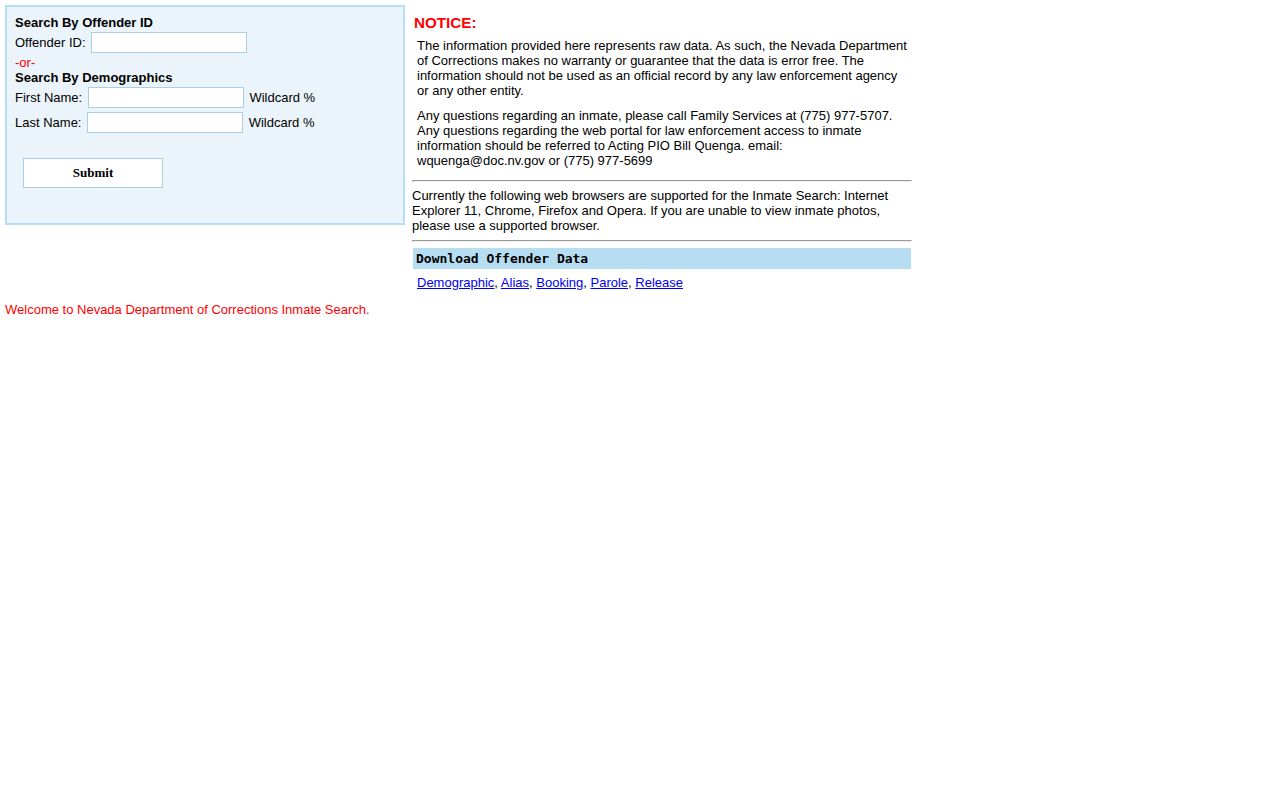
Its separate search and download choices help distinguish current placement, parole, and an actual release event.
Clark County Recent Release Search
CCDC publishes a current-custody search, not an official rolling list of releases in the last day or three days. It promises no post-release retention window, cadence, historical archive, or release-reason filter. The same is true of the local research for the other city jail systems. Do not substitute a scraper for an official Clark County feed.
To reconstruct a recent window, check people one at a time through the facility information line, detention movement records, letters, and court dockets. The Released Last 24 Hours page organizes the same-day fallback. Underlying CCDC case files can remain for decades even after a current name vanishes from the web.
Clark County Post-Release Supervision
The Nevada Board of Parole Commissioners handles parole decisions. Nevada State Police, Division of Parole and Probation handles field supervision. Board schedules or a grant are not gate records. Eligibility, an approved plan, other holds, and NDOC processing can still stand between a decision and physical release.
Casa Grande marks a local status boundary. Its residents may include people nearing eligibility, parolees, probation violators, and former offenders. Presence there is not proof of full discharge. Confirm individual custody through NDOC and supervision through NPP.
Clark County Release Notifications
Nevada ended VINE and VINELink service on August 29, 2025. The current state tool is NV S.A.V.E., which can search Nevada people in custody or under supervision and register available call, email, or text notifications. Agency feeds can lag, some jails can be offline, and a no-result is inconclusive. The retired four-digit VINE phone PIN process is historical and should not be used for a new registration.
S.A.V.E. does not replace federal systems. The BOP locator covers federal prisoners and can show a released result and date. ICE's nationwide detainee locator covers immigration custody. Henderson contract-houses U.S. Marshals and ICE detainees, so leaving that city building can be a custodial handoff rather than community release.
Clark County Court Release Records
Municipal, Justice, and District Courts handle different Clark County matters. Docket minutes can show dismissal, bond, sentencing, remand, or a release order after a jail name disappears. The detention record supplies the physical exit or transfer. Use the District Court records inquiry for district matters and the appropriate city or Justice Court portal for its own cases.
Search by the exact case number when possible. A docket may explain why custody authority changed, but only the holding or receiving agency can resolve whether the person actually entered the community.
Clark County Release Turnover
Henderson reported 8,717 bookings and 8,780 releases during 2024, with an average daily population of 312. The dated figures describe one municipal facility, not the whole county. They show why a present-tense locator cannot serve as a historical release archive. High turnover can move a name off the public view while a durable agency file continues to exist.
Clark County Custody Status Sources
Match the question to the system. A current roster answers who is held now. A release record answers what ended that custodian's stay. State and federal searches cover their own institutions, not every Clark County arrest.
| Source | Best use | Main limit |
|---|---|---|
| CCDC or city roster | Present local custody | Absence does not prove release |
| Detention release record | Actual local exit, reason, or transfer | Must be requested from the right custodian |
| NDOC offender and Release data | State prison placement, parole, or discharge | Does not cover a county-only jail stay |
| Court docket | Legal basis and case disposition | Does not always show physical gate time |
| BOP locator | Federal custody or released status | Does not cover local or ICE custody |
| ICE locator | Current immigration detention | Placement can change and release history is limited |
Clark County Release Facilities
The local map includes CCDC and North Valley, three city detention systems, Mesquite, the Boulder City contract path, six NDOC institutions or placements, and juvenile detention. Each page below uses the release route for that facility type. A prison discharge goes through NDOC; a municipal jail record stays with its city; juvenile information is restricted.
- Clark County Detention Center and North Valley Complex share the CCDC custody and records route.
- Las Vegas, Henderson, and North Las Vegas maintain municipal paths.
- Mesquite and Boulder City detainees at Henderson require the matching city and court records.
- HDSP, SDCC, FMWCC, Jean, Three Lakes Valley, and Casa Grande use NDOC records.
- Juvenile detention has restricted access and is not shown in the adult CCDC search.
Search Public Records
Sponsored Results