
Clark County Parole Versus Probation
Parole and probation both permit a person to live in the community under rules, but their legal sources differ. Nevada parole is a conditional release from a prison term. The Nevada Board of Parole Commissioners decides whether to grant, deny, revoke, or modify parole, while the Nevada Department of Public Safety, Division of Parole and Probation, commonly called NPP, handles field supervision. Probation comes from a sentencing court. NPP may supervise it, yet the court retains authority over the probation order and any later revocation or discharge.
Neither status is the same as unconditional discharge. Someone can be released from CCDC after receiving probation, leave an NDOC prison on parole, or move to a residential correctional setting without completing the sentence. The court docket, NDOC release description, and NPP confirmation should agree before a status is treated as settled.
| Point | Parole | Probation |
|---|---|---|
| Source | Conditional prison release | Sentence ordered by a court |
| Key decision maker | Nevada Board of Parole Commissioners | Sentencing court |
| Clark County field agency | NPP Southern Command | NPP Southern Command when assigned |
| Best records | NDOC data, Board action, NPP | Judgment, docket minutes, NPP |
| End point | Discharge or sentence expiration | Court discharge or term completion |
- Parole
- Conditional community release during a prison sentence.
- Probation
- Court-ordered community supervision with stated terms.
- Discharge
- The formal end of the applicable sentence or supervision term.
- Absconder
- A supervised person alleged to have stopped reporting or left supervision without permission.
Verify Clark County Post-Release Supervision
Begin with the last known custodian. A CCDC release may lead to probation, but the county jail’s current roster will not establish that supervision. An NDOC prison release may be parole, mandatory parole, residential placement, or discharge. The NDOC offender search and its separate Parole and Release downloads help distinguish those events. NDOC calls the portal raw data, so use the offender ID to match records and seek agency confirmation when details conflict.
- Confirm the person’s full name, offender ID, booking number, and court case number where available.
- Check the NDOC release and parole data for a prison event. Read the event description, not just the date.
- Review the correct Clark County court docket for a probation judgment, revocation, or discharge entry.
- Check monthly Parole Board actions if a hearing or parole decision is involved.
- Contact NPP’s Clark County office with the identifiers and ask which office can confirm public supervision information.
- Use NV S.A.V.E. as a notification and status aid, then verify important changes with NDOC, NPP, or the court.
A no-result is inconclusive. Names change, agency feeds update periodically, and local jail records do not cover state supervision. If the question concerns a county sentence rather than an NDOC term, the Eighth Judicial District Court, relevant Justice Court, or municipal court record is the more direct legal source.
Clark County Supervision Office
NPP’s Southern Command routes parole and probation supervision in the Las Vegas area. The local contact is useful after a record shows supervision but not the assigned unit. Do not rely on an office address to infer where a person lives or reports. Assignments may change, and public staff can limit information for safety, confidentiality, or an active case.
NPP Bonanza supervision office215 E. Bonanza Road
Las Vegas, NV
Phone: 702-486-3001
For release computation or an NDOC identity issue, contact NDOC Family Services at 775-977-5707 instead. The Parole Board answers decision and hearing questions at 775-687-5049 or info@parole.nv.gov. These agencies have different roles. Sentence Management computes dates, the Board makes parole decisions, and NPP supervises people in the community.
The Southern supervision office directory is the best starting point when Bonanza staff routes a caller elsewhere. Give a precise name and state identifier. Avoid asking staff to search broadly or reveal protected details.
Clark County Parole Hearing Records
The Nevada Parole Board hearing hub publishes monthly schedule PDFs, NDOC eligibility lists, violation schedules, condition-modification matters, lifetime-supervision items, early-discharge matters, and related action links. A name on an eligibility list is not a release approval. Hearings commonly occur before the minimum eligibility date, and schedules can change. A person may be removed from an agenda.
The official hearing page shown below helps locate the correct month and proceeding. It must be paired with the later action and NDOC release event.
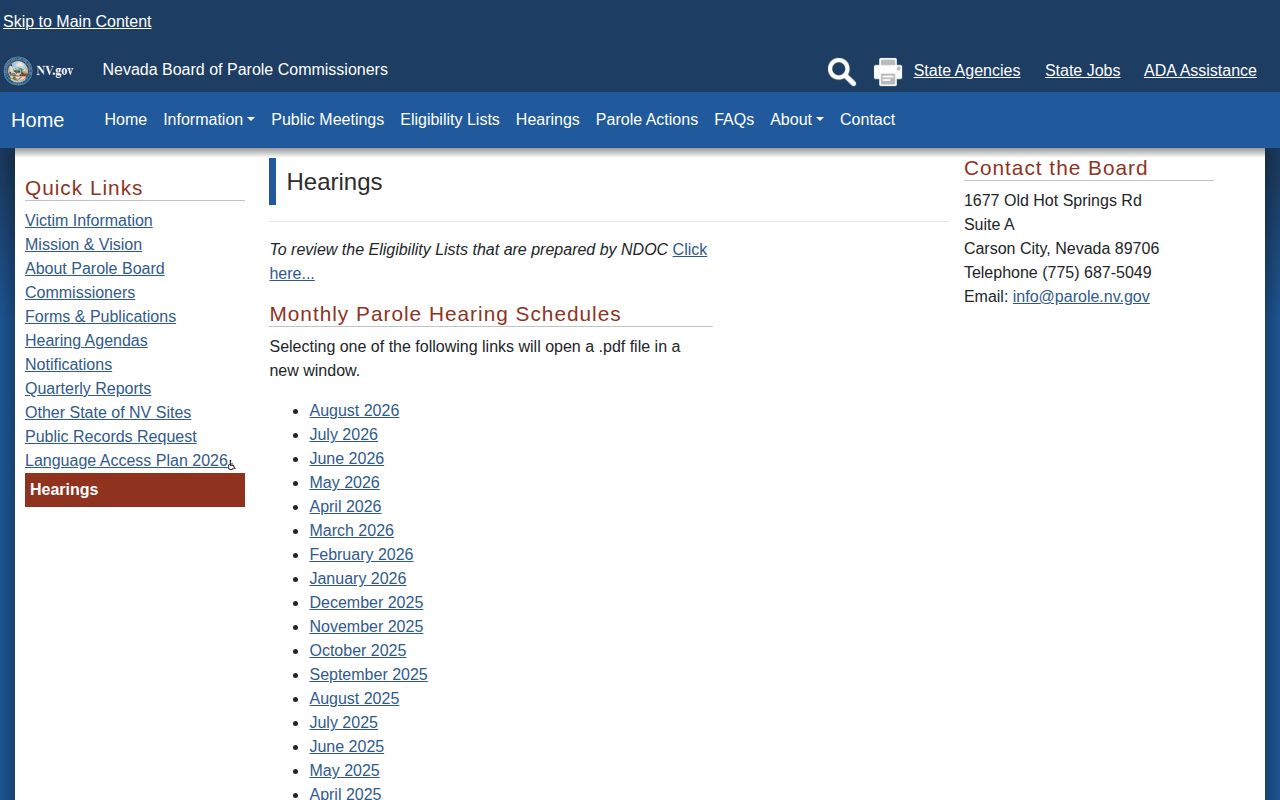
A grant still does not prove physical release. The eligible date must arrive, a plan must be approved, holds must be resolved, and NDOC must finish processing. Monthly action reports can show grant, denial, revocation, or no action. End-of-month cases may appear later, so compare the schedule with the Board’s action archive and NDOC data.
Clark County Violations and Absconders
Supervision conditions vary by order and person. They can concern reporting, travel, treatment, restitution, contact, testing, or other conduct. A suspected violation does not itself show the final result. NPP may investigate, a warrant may issue, and a parole panel or court may later continue, modify, or revoke supervision. Revocation means supervision was canceled and custody may resume; it is not the same as a new conviction.
NPP publishes a selective Wanted Fugitives PDF with photographs, identifiers, alleged violations, and extradition information. That list is not a complete registry of every Clark County absconder. Absence from it cannot confirm compliance, discharge, or the lack of a warrant. Use the named court docket, Board violation schedule, NDOC record, and NPP as appropriate.
Parole violation hearings are generally held on Tuesdays, with women’s violation hearings usually set for the third Tuesday. A panel recommendation can still require final Board approval. NV S.A.V.E. may provide a custody or supervision update, but it is not an official warrant record.
Note: Never confront a person based on a wanted-list image or an old supervision entry; report urgent safety concerns to the proper authority.
Casa Grande Release Status
Casa Grande Transitional Housing creates a distinct Clark County status boundary. NDOC describes residents who can include people nearing parole eligibility, parolees, probation violators, and former offenders. Its Las Vegas location may look less restrictive than a prison, but a placement there can remain part of corrections custody or structured supervision. The facility name alone cannot answer whether a sentence ended.
Read the individual NDOC booking, parole, and release records. If the entry describes placement at Casa Grande, confirm whether NDOC still holds the person, NPP supervises the person, or a later event shows community discharge. The same caution applies to Three Lakes Valley Conservation Camp and work release. Work outside a secure institution is not automatic sentence completion.
Full discharge should be supported by the actual agency record. When the portal is unclear, call NDOC Family Services and the assigned NPP office. A Clark County court docket can add the legal basis for probation, but it will not replace NDOC’s physical movement record.
Clark County Release Property Deadlines
Supervision questions can arise while a former CCDC inmate is also trying to finish jail business. Clark County allows former inmates to recover trust funds with valid photo identification or by mailing a notarized request to CCDC, Attn: Inmate Accounts, at 330 S. Casino Center Boulevard. Questions can go to inmateaccounts@lvmpd.com or 702-671-3900.
A released or transferred person has seven days to ask that an unfinished grievance or disciplinary appeal continue. The request may be sent to DSDRMA@LVMPD.com or mailed to the jail’s grievances and appeals unit. That deadline concerns the jail process, not parole reporting. A person on supervision should still follow the NPP instructions and dates in the release plan.
Las Vegas city detention also allows former detainees to request free downloads of scanned jail mail through its vendor. Property, funds, mail, and grievances are separate from a supervision discharge record, so keep receipts and agency responses with the person’s release documents.
Ending Clark County Supervision
Supervision ends through the authority that imposed or administers it. For parole, look for a discharge, sentence-expiration, or approved early-discharge record from the state system. For probation, read the sentencing court’s docket for a discharge or termination order. Simply completing a planned number of months is not enough when tolling, a violation, a modification, or lifetime supervision may apply.
Lifetime supervision is a separate obligation in qualifying matters. Board agendas can include people whose prison, parole, or probation term has expired while continuing conditions remain under review. Likewise, Nevada’s offense-specific registry is not interchangeable with parole. A person may finish parole and still have another legal duty.
After discharge, retain the official action, court minute, and release record. The broader Clark County released inmate search explains how to request the physical release or movement record from the correct custodian. If a public record is wrong, ask the originating office about its correction process rather than treating a third-party display as authoritative.
Clark County Supervision Records
Keep the judgment, Board action, NDOC release entry, and final discharge as separate records. Each answers a different question. If two dates or statuses conflict, ask the office that created the disputed field to explain or correct its own entry. A narrow request should give the offender ID, case number, order date, and exact field at issue.
Nevada’s public-records process reaches identifiable existing records. It does not require an agency to create a new legal conclusion about whether all duties ended. Ask for the discharge order or supervision-status record rather than a broad narrative.