
Clark County Projected Date Labels
NDOC uses several date labels that should never be collapsed into one promised release day. Sent. PEXD means Projected Expiration Date. Nevada sentence-credit materials define it as the maximum term with projected credits, including future work or good-time credits that still must be earned. PED is parole eligibility date, NPED is next parole eligibility, and MPR is mandatory parole release. A current earned expiration may count only credits already earned.
| Label | Meaning | What it does not prove |
|---|---|---|
| PEXD | Projected maximum expiration with assumed credits | Guaranteed exit date |
| PED | First parole eligibility point | Parole grant |
| NPED | Next eligibility after an action | Release approval |
| MPR | Mandatory parole release date shown by NDOC | Unconditional discharge |
| Actual release event | Recorded movement with description | Community freedom if it says transfer |
Always read the portal’s “up to date as of” date. Then compare the label to the sentence, Board action, holds, and later movement.
Find Clark County Release Dates
The correct path depends on custody. Use the NDOC offender search for a state prisoner. Use the judgment, jail timekeeper, and appropriate court for a county sentence. A person awaiting trial has no sentence expiration because bond and court orders, not a final prison term, control the exit.
- Identify whether CCDC, a city jail, NDOC, federal custody, or another agency holds the person.
- For NDOC, search by offender ID or name and record each date label exactly.
- Compare sentence start, minimum and maximum terms, PED, MPR, PEXD, and any listed holds.
- Check a Parole Board action when parole affects the timing.
- Ask NDOC Family Services or Sentence Management about conflicts; the Board does not compute time.
- After the estimate passes, find the actual NDOC Release event and read its description.
Clark County Sentence Credits
Through June 30, 2027, NRS 209.4465 generally provides 20 days per month for compliant service against the maximum term. Nevada law also defines credits tied to diligence, education, programs, and exceptional service. Eligibility is not uniform. Subsections 7 through 9 restrict when credits reduce the minimum or parole-eligibility term for important violent, sexual, DUI, category A or B, and other specified offenses.
For eligible cases after July 2014, subsection 9 caps reduction of the minimum aggregate term at 58 percent. “Aggregate” means the combined term used when sentences are calculated together. Credits may be forfeited or restored, and the governing rules depend on the offense date and controlling version of law.
Nevada does not impose a blanket 85-percent rule on every sentence. For many post-July 1, 1995 cases, parole eligibility follows the court-imposed minimum or combined minimum under NRS 213.120, subject to offense-specific restrictions.
Why Clark Release Dates Move
A sentence timekeeper begins with the judgment, minimum and maximum terms, sentence start, jail credit, concurrent or consecutive structure, and offense date. Concurrent terms run together to the extent ordered. Consecutive terms run one after another. A corrected judgment, new sentence, restored credit, forfeited credit, or aggregation change can alter the projected result.
Parole adds another layer. The Board may deny, grant, rescind, revoke, or defer action. Even a grant requires the eligible date, an approved plan, resolution of holds, and NDOC processing. A detainer, meaning another authority’s request to hold or receive the person, can turn an apparent exit into a transfer.
Effective July 1, 2027, NRS 209.4467 introduces a 35-percent framework with transition and election rules. As of the research date, that is future law. It should not be applied early or summarized as a universal release promise.
County Jail Release Computation
A CCDC detainee awaiting trial has no projected sentence expiration. Bond, own-recognizance orders, dismissal, detainers, and later court action control the timing. If a judge orders release, identity checks, other cases, holds, and jail workload can still delay physical departure.
For a sentenced county inmate, start with the judgment and the jail timekeeper under NRS Chapter 211, including NRS 211.310 and related provisions. Do not substitute the NDOC PEXD field for a county term. Ask the correct jail and court for the calculation and actual release record.
The Clark County District Court clerk can supply orders and minutes for applicable felony or gross-misdemeanor cases. Municipal and Justice Courts cover their own matters. The legal order and physical exit record should be reconciled.
Read Clark County NDOC Results
The NDOC form accepts an Offender ID or a demographic search with first and last name. It documents the percent sign as a wildcard. The separate Demographic, Alias, Booking, Parole, and Release downloads should be joined only by the official offender identifier. A similar name or photo is not a safe match.
The official search shown below is the Clark County starting point for a state-prison projected date and later release event.
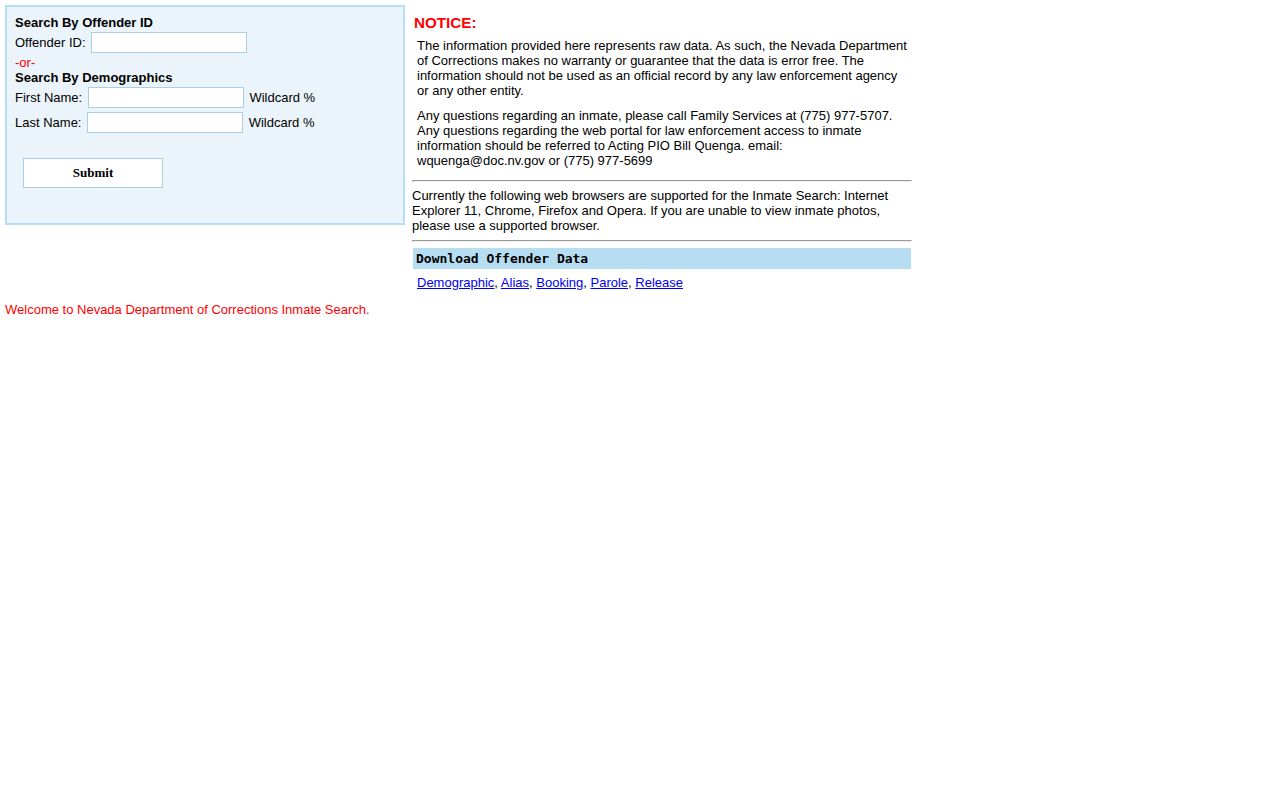
NDOC calls this public material raw data and says it should not serve as an official record. Capture the exact label, displayed update date, offender ID, and sentence context. When formal accuracy matters, request confirmation from NDOC rather than changing the meaning of an unfamiliar abbreviation.
Clark County Parole Date Check
The Parole Board hearing hub publishes monthly schedules, NDOC eligibility lists, violation matters, condition modifications, lifetime-supervision items, and early-discharge proceedings. Eligibility is the chance to be considered. It is not a grant, scheduled gate time, or actual exit.
Monthly actions may show grant, denial, revocation, or no action. A case heard near month-end may not appear until a later report, and schedules can change. If parole is granted, check whether the eligible date has arrived, a plan is approved, all holds are resolved, and NDOC has processed the movement.
Violation proceedings can also change timing. A panel may recommend continuing or revoking parole, subject to final Board approval. Compare the final action with NDOC’s current dates and actual release data. NPP supervises the person after community parole, but it does not replace Sentence Management’s computation.
Clark County Holds and Transfers
A detainer is another authority’s request to hold or receive a person. It can prevent an expected community release or change the destination at the same time one sentence ends. CCDC may transfer a person to NDOC, another local jail, ICE, or a federal authority. NDOC can likewise release someone to parole, residential placement, another jurisdiction, or a committing authority.
Read the destination field. Henderson’s contract populations make this especially important because the city holds U.S. Marshals, ICE, Clark County, and Boulder City detainees. Leaving Henderson’s building under another authority is not community release.
For a supported federal event, use the BOP locator or federal docket. For a supported immigration transfer, use ICE’s locator and information line. Do not add those checks to an ordinary county matter unless a hold, transfer, or case record points there.
Confirm Clark County Actual Release
Once a projected date passes, look for an actual event. NDOC’s Release download may supply a date and description. CCDC or a city jail can provide the detention movement record. The proper court docket supplies the legal order, but not necessarily the time the person crossed the exit.
- Record the projected label and the portal update date.
- Check for a later release or movement event.
- Read the event description and destination.
- Confirm parole with the Board action and NPP when applicable.
- Check the receiving custodian when the event says transfer.
- Request an official record if public sources conflict.
A release date should be stated with its source and type. “PEXD shown by NDOC” is more accurate than “gets out on.” “Actual CCDC release at the recorded time” is different from “court ordered release.” Precise wording prevents an estimate from becoming a false promise.
Clark Release Date Records
For CCDC, a focused LVMPD request can seek the existing booking and movement record, actual release date and time, disposition, destination, and any correction. Provide the full name, booking or inmate ID, case number, and a narrow date range. A Letter of Incarceration request may also ask whether booked and released dates can be certified, though the official page does not promise specific fields or timing.
Nevada’s Public Records Act generally requires an agency to act by the end of the fifth business day. The response can provide access, identify the proper custodian, cite authority for denial, or state when the record is expected. It is not a guarantee that a complex record is finished in five days.
For NDOC, identify the offender ID, book ID, date label, release description, and sentence at issue. A narrow request lets Sentence Management or the correct records office address the disputed computation without being asked to create a new report.
After Clark County Release
Parole, probation, work release, transitional housing, and full discharge are distinct. Casa Grande residents can include people nearing eligibility, parolees, probation violators, and former offenders. Three Lakes Valley is a minimum-custody or work-release camp. Being outside a traditional prison at either location does not itself prove sentence completion.
If the actual event says parole, verify the NPP Clark office and retain the Board action. If it says another NDOC institution, custody continues. If it says discharge, keep the release entry and any final sentence record. The Clark County parole and probation page explains how to separate active supervision from final discharge.
Lifetime supervision can continue after another prison, parole, or probation term ends in qualifying matters. A projected expiration date must not be used to infer that every state obligation has ceased.
Clark County Date Disputes
When a projected date appears wrong, compare it with the signed judgment. Note the sentence start, jail credit, minimum and maximum terms, concurrent or consecutive structure, offense date, and each credit field. Identify any amended judgment or Board action.
Send the discrepancy to the office that computes the term. NDOC Sentence Management handles state timekeeping, not the Parole Board. A county jail timekeeper applies a county judgment under Chapter 211. The court clerk can supply the filed order but does not replace the custodian’s movement log.
Keep the correction response and updated record. A changed PEXD remains a projection until an actual release event occurs. Record the portal update timestamp so a later reader can tell which calculation was displayed when the question arose.